

What a business-ready market report contains
The LEO Market Report combines geographic context with practical area insight. For a selected radius or polygon, it can include:
- an area map and boundary overview;
- population and demographic context;
- household income ranges;
- the age profile of the area;
- employment status insight;
- nearby shopping-centre context; and
- surrounding retail visibility.
These elements help answer connected questions: Who lives around the opportunity? Does the market align with the target customer? What retail choices already exist? How should the site be compared with another candidate?
Because the structure remains consistent, the report is useful across more than one opportunity. Teams can compare areas without rebuilding the evidence pack from unrelated sources each time.
Use reports at each stage of the expansion funnel
Retailers can use market reports throughout the process:
- Initial screening: Confirm whether a broad area warrants more investigation before detailed property work.
- Site shortlisting: Create a comparable market view for each serious option. How to Compare Two Business Locations More Effectively sets out a fair comparison method.
- Business-case development: Add structured market evidence to the property, operational and financial case.
- Stakeholder review: Give decision-makers a concise reference for questions about customer fit, local context and competing retail.
- Decision record: Retain the market view and assumptions that supported the recommendation.
- Portfolio learning: Revisit reports later to compare the original market hypothesis with how the location and network developed.
The report becomes more valuable when the business uses it as part of a repeatable decision process rather than a once-off attachment.
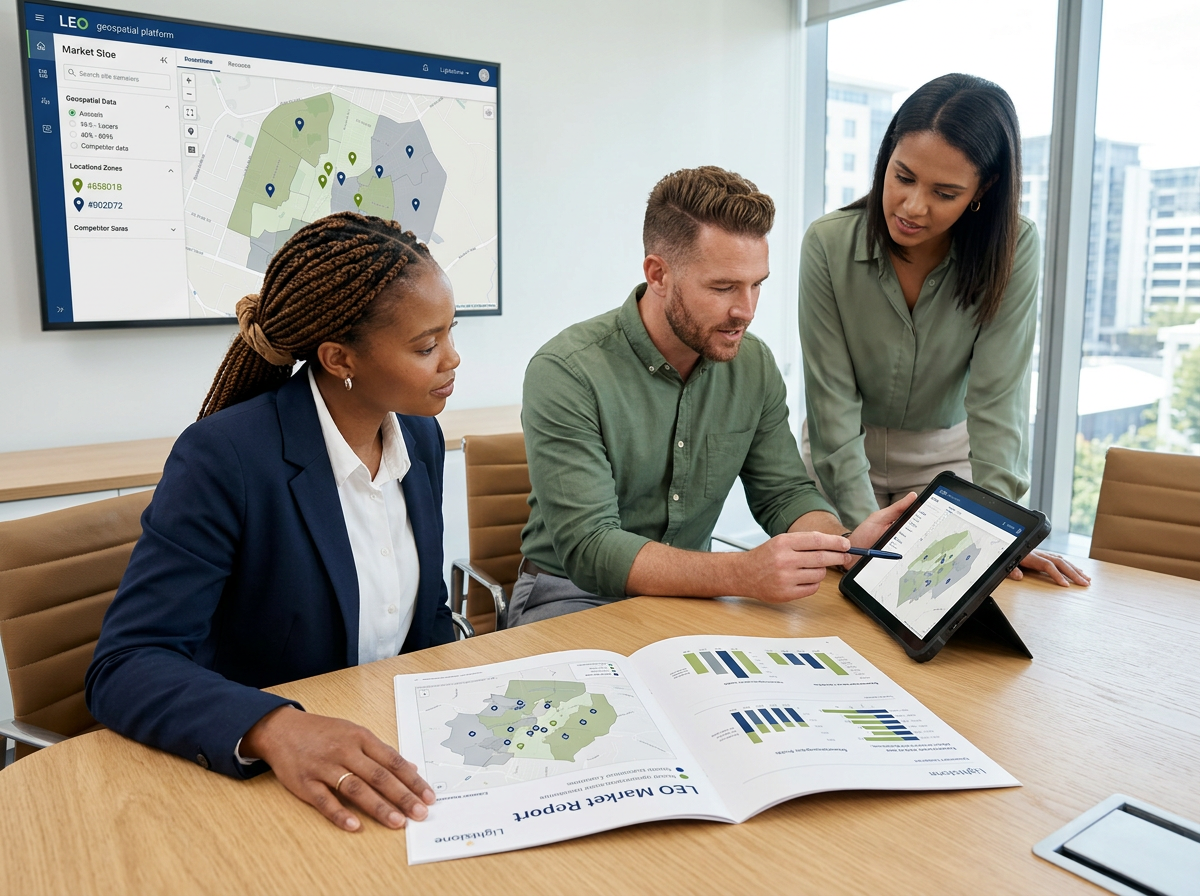
Create an editorial scene showing a printed and digital LEO Market Report open in a retail expansion meeting. Visible pages should include an area map, demographic profile, income bands and nearby retail context. In the background, show three team members discussing the report beside a screen with the same site in a geospatial platform. Use generic data and no invented performance numbers.
Make a complex market easier to discuss
Maps and visual summaries help stakeholders see relationships that a spreadsheet can obscure. A report can show where the boundary sits, how the population is distributed and which shopping centres or retailers form part of the local environment. Demographic sections explain the people behind the place without requiring every reader to operate the analysis platform.
A useful market report does more than summarise data. It gives every stakeholder the same market view from which to challenge, refine and support the expansion case.
Explore first, then report the decision-relevant view
A report is strongest when it follows thoughtful investigation. LEO, Lightstone’s interactive geospatial platform, allows analysts to explore locations, test radii or polygons, compare areas and view demographic and retail context on a map. The team can follow unexpected patterns, adjust assumptions and decide which boundary best represents the question.
Once the relevant area is agreed, a Market Report can be generated in minutes. The report translates the selected map view into a presentable output, while LEO remains available if the committee asks for a different boundary, an additional comparison or deeper context.
This distinction keeps each tool focused on its role:
- LEO supports exploration and analysis.
- The Market Report supports communication and alignment.
Both are built on Lightstone’s South African retail expertise and annually updated demographic and location information. That foundation includes more than 1,900 malls, 60,000 stores, 19 lifestyle segments and more than 100,000 enumerated areas.
Present evidence without overstating certainty
A market report should strengthen judgement, not replace it. Pair the location insight with property terms, capital requirements, operational feasibility, access validation and an on-site assessment. State the target customer, intended store role and important assumptions in the recommendation.
Avoid selecting only the measures that support a preferred answer. If competition is strong, catchment overlap is possible or the target-market fit is mixed, make that visible and explain how the business plans to respond. How to Reduce Risk When Choosing a New Store Site provides a useful framework for this review.
A transparent report improves the quality of the discussion. It allows a committee to approve the opportunity with conditions, request specific validation or decline a site for reasons that can be understood later.
How to get more value from a market report
- Define the business question and study area before generating the report.
- Use the same report structure when comparing multiple locations.
- Connect demographic measures to the target customer and store format.
- Explain risks and assumptions instead of presenting only favourable evidence.
- Combine the report with property, operational, financial and field validation.
- Keep LEO available for exploration and use the Market Report as the shared decision output.

Create the market view for your next expansion discussion
Explore and refine the opportunity in LEO, generate a Market Report for any selected radius or polygon in minutes, or talk to Lightstone Explore about the reports and platform access that suit your planning process.
From location analysis to a recommendation people can act on
Market reports help retail teams turn complex area analysis into a consistent and practical business conversation. Used from screening through approval, they support fairer comparisons, clearer assumptions and better stakeholder alignment. The strongest approach combines LEO’s interactive geospatial analysis with the Market Report’s decision-ready structure, then adds the commercial and on-the-ground evidence required for the final call. Continue with What to Consider Before Opening a New Retail Location or From Map to Decision: How Location Intelligence Supports Retail Recommendations.