

Define the job the new location must do
Every site should respond to a clear commercial objective. One store may be intended to enter a new town; another may close a coverage gap, relieve pressure on an existing branch or give a brand access to a different customer segment. A smaller convenience format and a destination store can succeed in the same market for very different reasons.
Start by stating the decision in practical terms. What customer need should this location serve? Which part of the network will it strengthen? What evidence would show that the opportunity is attractive, and what finding would cause the team to walk away?
This definition prevents the property from setting the strategy and gives teams a consistent basis for screening alternatives. A new-market entry should emphasise target-customer depth and competitive conditions; network infill should focus on existing catchments and cannibalisation risk.
For a broader approach to managing uncertainty, see How to Reduce Risk When Choosing a New Store Site.

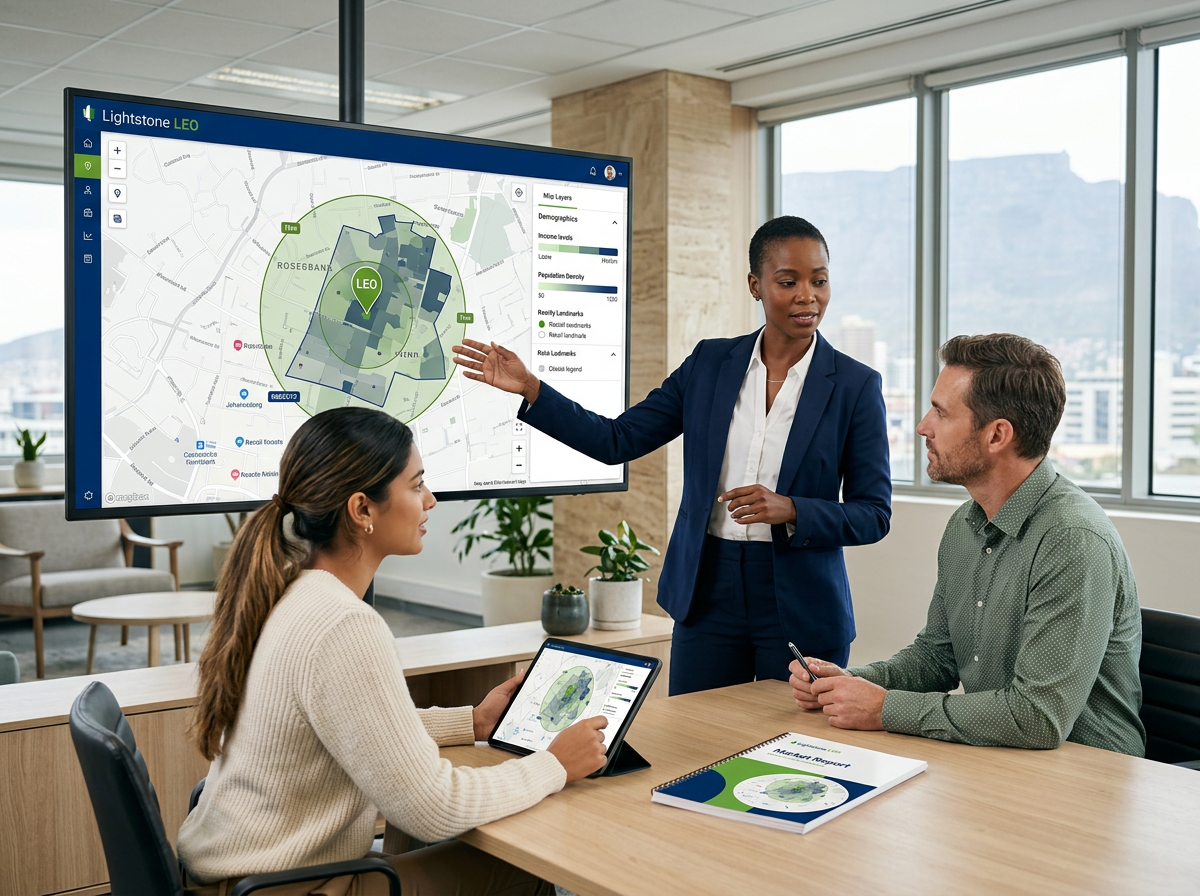
A clean South African retail-planning map showing a proposed store pin, a custom catchment polygon shaped by major roads, target-customer density shading, existing stores, shopping centres and competitor locations. Include a small side panel summarising population profile, income bands and employment indicators; avoid implying a performance forecast.
Test market demand and customer fit together
Population alone does not make a retail market. A large local population may contain too few customers who fit the brand, while a smaller area may have a stronger concentration of suitable households. Review age, income, employment, household composition and lifestyle characteristics alongside the brand’s customer profile and store format.
Then define a realistic catchment. A radius is a useful starting point, but roads, travel time, physical barriers, retail destinations and competing centres influence how people move. Examine the market inside the likely trade area, not only the suburb or municipal boundary in which the property sits. What Is Catchment Analysis? explains how this geographic view strengthens site evaluation.
Look for depth as well as fit. Does the catchment contain enough of the right customers? Is there a daytime market in addition to residents? Could the area support the proposed format without optimistic assumptions?
Check the network effect, not only the local opportunity
A site can appear strong in isolation and still weaken the network. Plot nearby branches and review how their effective catchments may overlap with the proposed store. Consider whether customers would be newly reached or merely shift between locations, and whether a different placement could create better total coverage.
Competition also needs context. A cluster of established retailers may confirm that an area functions as a destination, but it may also mean customers already have strong alternatives. No nearby competitor could indicate white space—or limited demand. The useful question is not simply “Who is present?” but “What does the retail landscape reveal about market behaviour, customer choice and the role our offer could play?”
LEO, Lightstone’s interactive geospatial platform, brings existing stores, surrounding retail, demographic context and internal business data into one map-based view. This allows teams to test a proposed site as part of the full footprint rather than treating it as a standalone pin.
A lease secures a property. Evidence establishes whether that property deserves a place in the network.
Separate market strength from site quality
A strong market cannot rescue every property. Once the broader area passes the demand test, investigate the physical site: visibility, access and egress, parking, pedestrian movement, vehicle flow, store configuration, neighbouring tenants, delivery requirements and planned developments. Rental and lease terms must be weighed against realistic market potential, not against enthusiasm for the location.
Fieldwork remains essential. Visit at different times and on different days. Observe how people enter, move through and leave the precinct. Confirm planned roads, developments and centre changes with the relevant sources. Speak to operations teams about practical constraints that a map cannot show.
Keep market and site findings separate in the recommendation. This makes it easier to distinguish a promising market with a weak available property from a good-looking property in a weak market. It also protects the team from forcing a yes/no answer when the better conclusion is to continue searching within the area.
The pre-opening checklist
- Give the proposed store a clear strategic role before assessing properties.
- Test demographic fit, market depth and catchment conditions together.
- Review competitors and complementary retail as market signals, not automatic answers.
- Measure possible overlap with the existing network before assuming sales will be incremental.
- Validate visibility, access, parking, configuration and lease fundamentals on site.
- Record assumptions, risks and evidence gaps so decision-makers can see what remains uncertain.
- Compare alternatives using the same criteria rather than defending the first attractive option.
Build a location recommendation your business can stand behind
Use LEO to explore a proposed site, draw a radius or custom polygon, review annually updated South African demographic and location data, and compare the surrounding retail landscape. When the analysis is ready to share, generate a business-ready Market Report in minutes for the selected area, bringing map context, demographics, income, employment and nearby retail into a structured output.
Talk to the Lightstone Explore team about the sites on your shortlist and how LEO can support a more consistent pre-opening process.
Make the opening decision before the lease makes it for you
The right new retail location is where strategy, customer demand, network fit and site quality align. No single dataset or property feature can establish that on its own. A disciplined assessment combines commercial experience with credible location evidence, then makes the remaining assumptions visible.
That approach may confirm the site, redirect the search or show that the market is not ready. Each is a useful outcome when it is reached before capital and time are committed. The goal is not to remove judgement from retail planning; it is to give judgement a clearer, more defensible foundation.