

Separate store performance from location potential
Performance tells you what happened at the store. Location analysis helps explain the market in which it happened. Neither should be used as a substitute for the other.
Start with the internal picture: sales and margin trends, costs, lease exposure, stock availability, store format, operational consistency and any suitable customer or transaction information. Compare the store with relevant peers rather than only a network average. A small convenience branch and a large destination format are not useful benchmarks for each other.
Then examine the location:
- Does the current catchment contain enough of the target customer?
- Has the demographic or retail context changed?
- Is the site easy for the intended market to reach and use?
- Are competitors or nearby stores changing the location’s role?
- Does the store add meaningful coverage to the network?
- Is the problem the market, the property, the format or execution?
How to evaluate whether your current store is in the right place provides a deeper checklist for this diagnosis.
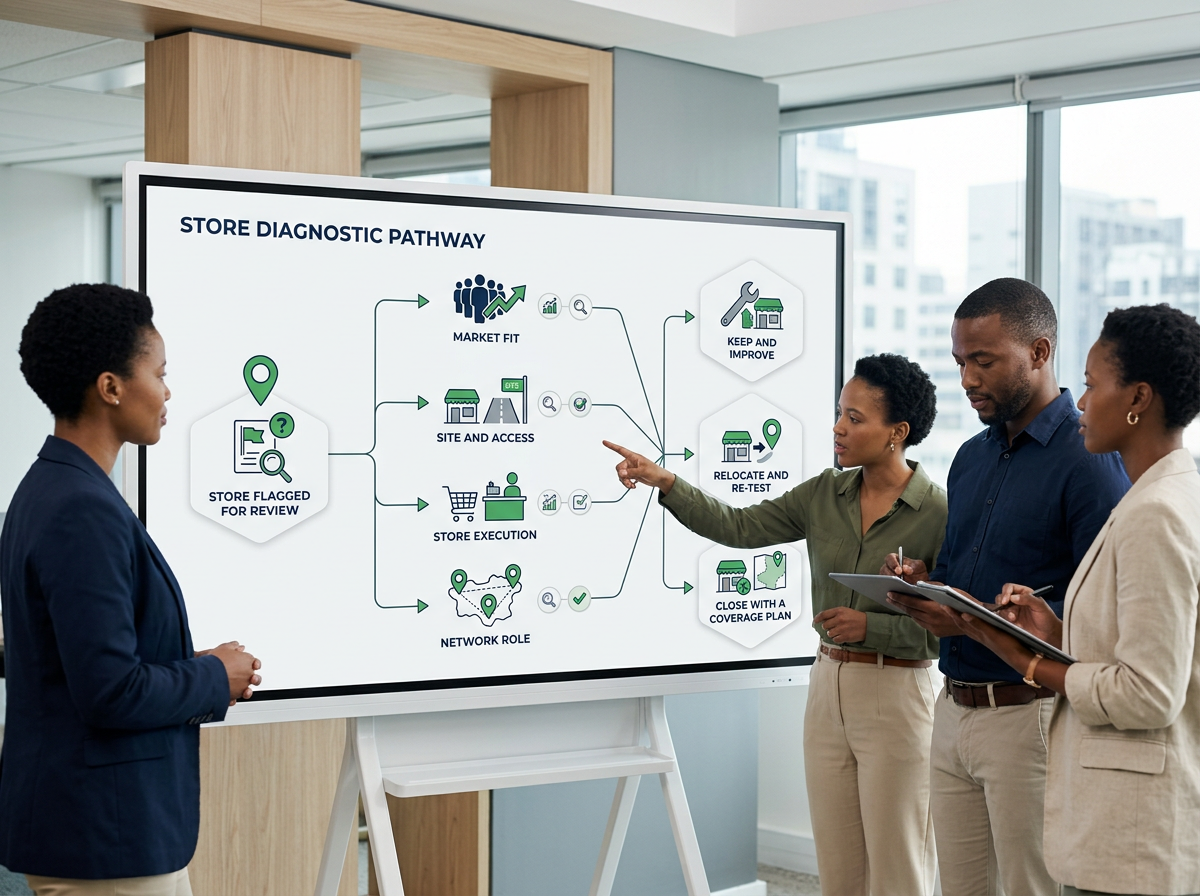
Create a decision tree beginning with “Store flagged for review”. The next level has four diagnostic branches: Market fit, Site and access, Store execution, and Network role. Converge these into three balanced outcome cards: Keep and improve, Relocate and re-test, or Close with a coverage plan. Use question marks and evidence icons; do not depict any option as automatically positive or negative.
Use a three-path decision framework
Once the store and market have been assessed separately, test each option against the same evidence.
Keep becomes credible when the market still fits, the location has a clear network role and the performance gap can plausibly be addressed through operations, range, format, marketing, property terms or targeted investment.
Relocate becomes credible when the broader market remains attractive but the current property constrains access, visibility, catchment reach, format or cost. The alternative site must be assessed as a new investment, including its effect on nearby stores.
Close becomes credible when the market no longer fits, the store has limited strategic coverage, recovery options are weak or the economics remain unsustainable after realistic changes are considered.
LEO, Lightstone Explore Online, helps teams map the current store, possible alternatives and the wider network in one geospatial platform. It combines annually updated South African demographic and location data with retail context and a team’s own mapped information, helping the business compare scenarios rather than reviewing the store in isolation.
Compare the current catchment with the alternative
Relocation decisions often receive less scrutiny than new-store proposals because the business already knows the area. That familiarity can hide a critical question: will the alternative site serve the same customers, reach a better market or merely move the pin?
Define a realistic catchment for the current and proposed locations. Compare target-market presence, income and age profile, employment context, nearby retail, shopping centres, access and network overlap. Where customer-origin information is suitable and available, use it to understand which current relationships may be retained and which may be lost.
Also model the gap that a closure or move could leave. Another store may absorb most demand, or the change may surrender a strategically important area. If neighbouring stores already share the market, the review should consider what retail cannibalization is and how to spot it in your network.
A comparison need not treat the options as equal. Its purpose is to expose differences before a preferred outcome gathers momentum.
“A weak store is a signal to investigate. It is not, by itself, evidence that the market should be abandoned.”
Give decision-makers one consistent market view
That principle works in both directions. A historically strong store should not be protected from review if its market, cost base or network role has changed materially.
Store decisions cross functions and can become emotionally charged. A long-standing location may have internal supporters; a new property may create excitement. A consistent evidence pack helps the discussion stay focused on the business case.
The LEO Market Report can be generated in minutes for any selected radius or custom polygon. It turns the mapped area into a structured output covering population, household-income ranges, age, employment, nearby retail and shopping-centre context. Generate comparable reports for the current store and serious alternatives, then add the relevant internal financial, operational, lease and customer evidence.
The final recommendation should state the option, expected network effect, important assumptions, transition implications and triggers for review. For a store that remains open, set specific actions and a review date. For a relocation, define what the new site must improve. For closure, plan how customers and network coverage will be managed.
This portfolio perspective connects directly to how South African retailers are using data to future-proof their store networks.
Key takeaways
- Treat underperformance as a trigger for diagnosis, not an automatic closure case.
- Separate market potential, property constraints, store execution and network role.
- Compare the current store and relocation options using consistent catchments and indicators.
- Assess the effect on neighbouring stores and any coverage gap a change could create.
- Combine LEO market analysis and Market Reports with internal commercial and operational evidence.
- Attach clear actions, assumptions and review triggers to the final decision.

Compare the options before committing to the outcome
Use LEO to place the current store, relocation candidates and wider network in the same South African market view. Generate a business-ready Market Report for each relevant radius or polygon, then talk to the Lightstone Explore team about a clear, comparable location-review workflow.
Make the call at store, market and network level
Closing, relocating or keeping a store is rarely a one-metric decision. The strongest answer connects current performance with the surrounding market, the suitability of the property, the store’s role in the network and the economics of every realistic alternative.
Location intelligence cannot make the call on behalf of the business. It can show what each option means geographically and demographically, giving decision-makers a clearer basis for acting — and a transparent record of why they did.